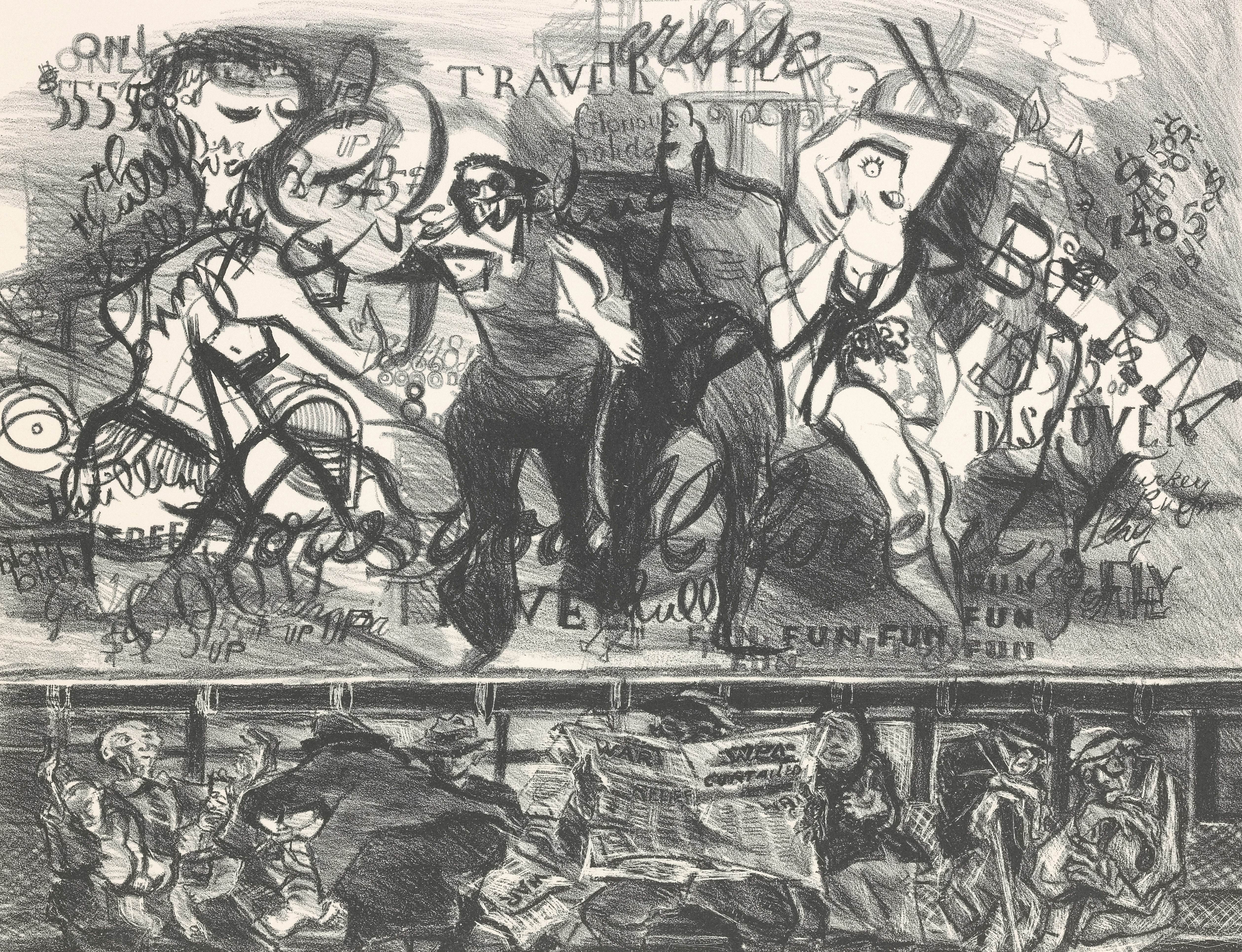
Protest art takes its shape in various forms, emerging as creative elements that challenge and criticise the injustice powerplay in society. Political cartoons and caricatures have long had a dual purpose: to critique political figures and to entertain the masses. Whether it was the Roman satirical drawings, James Gillray’s political cartoons or Benjamin Franklin’s 1754 “Join, or Die” urging unity, caricatures have found witty ways to send a message.
By the late 19th century, this powerful tool was deployed by artists in colonial Bengal to critique British authority and the hypocritic ‘Babu culture’ (a mix of English influence and Bengali culture that led to a hybrid class). In the struggle for freedom, this hybrid class who mimicked colonisers were often seen as the enemy within. Amid low literacy rates in 19th century Bengal, pervasive caste hierarchies and the stark discrimination between the Indian public and the British, visual satire emerged to create a new public platform.
EARLY SATIRE IN THE COLONIAL PUBLIC SPHERE
Colonial Bengal learned a lot from the London-based satirical magazine Punch, founded in 1841. This magazine ridiculed the colonised subjects of the empire and often showcased imperial stereotypes. Srimati Ghosal while tracing the development of visual satire in colonial Bengal observed how “Bengal had its caricature magazines modelled on Punch, and cartoonists who put up a strong resistance against the rule of the colonial masters through humour and mockery.”
Satire was reinterpreted locally. It became a new language of resistance, adopted by early journals like Harbola Bhand and then Basantak. Harbola Bhand paved the way for Basantak which was first launched on 31 January 1874. Often referred to as the Bengali Punch’, Basantak was founded by Prannath Dutta and edited with his brother Girindranath Dutta, both activists of the Municipality Movement for Calcutta. One of the most famous caricatures from the magazine is the portrayal of Sir Stuart Saunders Hogg, Chairman of the Calcutta Municipal Corporation as the boar figure of Vishnu (Fig. 1).

Fig 1. (Basantak archives, vol. 2, no. 1 / Heidelberg)
The third incarnation of Vishnu, the boar figure known as the Varaha, is said to have killed the demon Hiranyaksha who stole the Earth Goddess Bhumi. Varaha is shown as lifting the Earth on his tusk, embodying the role as the preserve and protector. Playing on the name “Hogg” as a literal pig, it showcases him as a half-boar, half-man figure, using a mock heroic style as the figure lifts Calcutta on its tusk. Sourav Chatterjee in “Against Imitation: Anti-Colonial Caricatures in Basantak, or the Bengali Punch” highlighted how “supplicating zamindar (a feudal landlord) on the left and the British official on the right pray to the mighty Hogg (hog) not to destroy the city.”

Fig. 2 (Basantak archives, vol. 1, no.1 / Heidelberg)
Basantak mocked Hogg on numerous occasions. One notable caricature depicts him as a magician, capable of making money disappear. Translated, this caricature (Fig. 2) is entitled 600,000 Rupees from Municipal Collections. He stands with an empty safe in one hand while the model of Hogg market is set up on the table. The satire alludes to the Calcutta Markets Act (VIII of 1871) which allowed the Calcutta municipality to borrow 600, 000 rupees to establish a market. Stuart Hogg who served as Chairman of the Calcutta Municipal Corporation is pictured standing tall and firm with his demands. However, the figures at the table are concerned about their money. The caption tells us that the first collection of money ‘disappeared’, with newspapers like Amrita Bazar Patrika accusing Hogg of money embezzlement.
In the same time frame, the Bengali newspaper Sulav Samachar also targeted the British Raj and European settlers. Edited by Umanath Gupta, it is said that the circulation increased from 1,000 copies initially to 8,000 in the span of two months. Some of the common subjects were the oppression of the peasants by their zamindars, criticism of the administrative system, excessive taxes and the increased price of commodities. In Cartoons of the Raj, Partha Mitter shed light on a provocative cartoon published by Sulav Samachar in the 1870s that mocked the Empire. The cartoon showed a dead coolie (a luggage carrier in India), his weeping wife, and a European doctor who “conducts a perfunctory post-mortem while the offender stands nonchalantly smoking a cigar.”
THE BABU AS A FIGURE OF MOCKERY
In historical terms, Babu figures in Bengal were the elite class of the 18th and 19th century: a respectable title which soon lost its full value. They were educated and often belonged to noble families. The Babu became a common subject for the Kalighat painters, the patuas of Bengal who were known for their devotional painting and scrolling painting called Patachitra. With time, the Kalighat painters expanded their art of everyday subjects and ridiculed the Babu. The Cleveland Museum’s English Babu (Native Indian Clerk) Holding a Hookah from 1890 is one example. The Babu became an embodiment of performative mimicry and moral weakness. Often stereotyped with oiled hair, hookahs and pleated dhotis, these paintings exposed the pretension that fuelled colonial exploitation.
Artists like Gaganendranath Tagore developed this further during the Swadeshi Movement (1905-1920s), using satire to expose the Babus. Born into the prestigious Tagores family, Gagenendranath was the nephew of Rabindranath Tagore and brother of Abanindranath Tagore. He was an exceptional figure from the Bengal School of Art, whose caricature ‘Confusion of Ideas‘ from his collection Realm of the Absurd in 1917 satirises Babus’ hypocrisy. Fig. 3 showcases two hybrid Babus at the temple: one performing a traditional namaskar (ironically for Hindus, a forbidden animal—a chicken) from his pocket, while the other raises his British hat to the deity with a cigarette in his hand.

Fig. 3 (Pub. domain)
Another caricature Nuisance of a Wife from the same collection satirises anglicised Babus’ double standards and the superficial adoption of Western liberalism. Figure 4 shows an excessively fat Babu wearing Western shoes and strolling ahead with a cigarette in his hand. His wife walks behind, burned with the load of the luggage, her children, a lamp and a water bottle. This reflects the society and the majority of the Babus of that time who were rooted in patriarchal tradition. While they prioritised Western status and seemed to be adopting English traditions, they also refused to treat their spouse as equal.

Fig. 4 (Pub. domain)
DEVELOPMENT OF VISUAL SATIRE AND OTHER ARTISTS
Gaganendranath Tagore also mocked British officials and critiqued their rule. His lithograph “Terribly Sympathetic” showcases a bespectacled British official stomping a bunch of silhouettes. Figure 5 represents Sir Joseph Bampfyle Fuller, first Lieutenant Governor of Eastern Bengal and Assam. The title drips with irony as this composition critiques Fuller’s repressive policies, including his role in the 1905 Bengal Partition and paternalistic attitude disguised as fake sympathetic rhetoric.

Fig. 5 (Pub. domain)
Gaganendranath Tagore’s painting titled “The first Bengali Governor, where is H.E.?” was created in 1920 amid the Montagu–Chelmsford reforms / Government of India Act debates in 1919. This saw a change in the administrative reforms and openings for Indian officials into higher offices. In the painting, various bureaucrats are standing on a global-like figure with ‘India’ inscribed on it. The British officials are scouting for loyalists who would copy their imperial style. Satyendra Prasanna Sinha, the first Indian governor of the province of Bihar and Orissa, did not bring about major changes. While he did advocate for some reforms, the power remained in the hands of the British government.
The Bengal Famine of 1943 that killed nearly 3 million people is known as one of the most haunting episodes in Bengal’s history. Largely due to the colonial wartime policies and mismanagement, Winston Churchill’s war cabinet refused to send any grain to Bengal. Chittaprosad Bhattacharya, a member of the Communist Party of India used his art and caricature to capture the atrocities. His original publication “Hungry Bengal: A Tour Through Midnapur District’’ in 1943 was banned by the British Government. This booklet contained over 20 sketches that documented the plight and suffering of the people. Satish Das (Fig. 6) from this collection showcases the sketch of a young man who is orphaned after his entire family died due to the Bengal famine of 1943.

Fig. 6 (DAG Museum)
The sketches had a significant impact abroad, leading to the establishment of a Famine Inquiry Commission. Shanibarer Chithi, a monthly Bengali literary magazine also played a role especially during the two nation theory. From the 1940s onward, satire had become very much a mobilisation tool during the Quit India Movement. Other artists including Kafi Khan and Pramatha Samaddar continued to mock the leadership of Churchill and other government sectors. As the period of freedom approached, visual satire was published in newspapers and magazines on a weekly basis.
As Nimai Mandal commented on this topic, “(visual) art became a powerful tool for the oppressed to express resistance against their oppressors…” Every cartoon, sketch or caricature which targeted the Empire and double standards of the Babus, contributed to the invention of a shared visual vocabulary. Much of this evolved further post-independence and continues to be a powerful tool to critique oppressive practices. Using their art to evade all kinds of censorships and brutal press acts, these artists made the colonisers a laughing stock.
References
- Ghosal, S. Political Caricature in Colonial Bengal (1872-1947). Sahapedia. Available from: https://www.sahapedia.org/political-caricature-colonial-bengal-1872-1947
- Chatterjee, S. Against Imitation: Anti-Colonial Caricatures in Basantak, or the Bengali Punch.” Victorian Periodicals Review. 2023; 56(1); 1-44. Available from: https://dx.doi.org/10.1353/vpr.2023.a905138
- Mitter, P. Cartoons of the Raj. History Today. Sep 1997; 16-21. Available from: https://www.csus.edu/indiv/o/obriene/art109/readings/partha%20mitter%20cartoons%20of%20the%20raj.pdf
- Banerjee, A. The Satirical Caricatures of Gagenendranath Tagore. An Interdisciplinary Journal of Literary Studies. July 2018; 111 (11); 33-52. Available from: https://postscriptum.co.in/wp-content/uploads/2018/07/pS3.iiAnavisa.pdf
- Mandal, N The Growth and Development of Caricature in Print Media of Bengal (1872-1947). JHSR. 2025; 5 (2); 313-332. Available from: https://www.jhsr.in/wp-content/uploads/2025/08/313-332-JHSR-V5-N2-NIMAI-MANDAL.pdf
Author bio: Shelton Mark Rozario is a penultimate-year student at St. Xavier’s College (Autonomous), Kolkata, pursuing a B.A. in English (Hons). He is passionate about history, politics and culture. Shelton has worked with various organisations as a content writer and contributes as a fact-checker for DigitEYE India, an IFCN signatory.
Join the discussion here