Part 7 of personal reflections and historic explorations of the Grafton to Cairo length of Illinois Route 3 by writer and poet Richard Stimac.
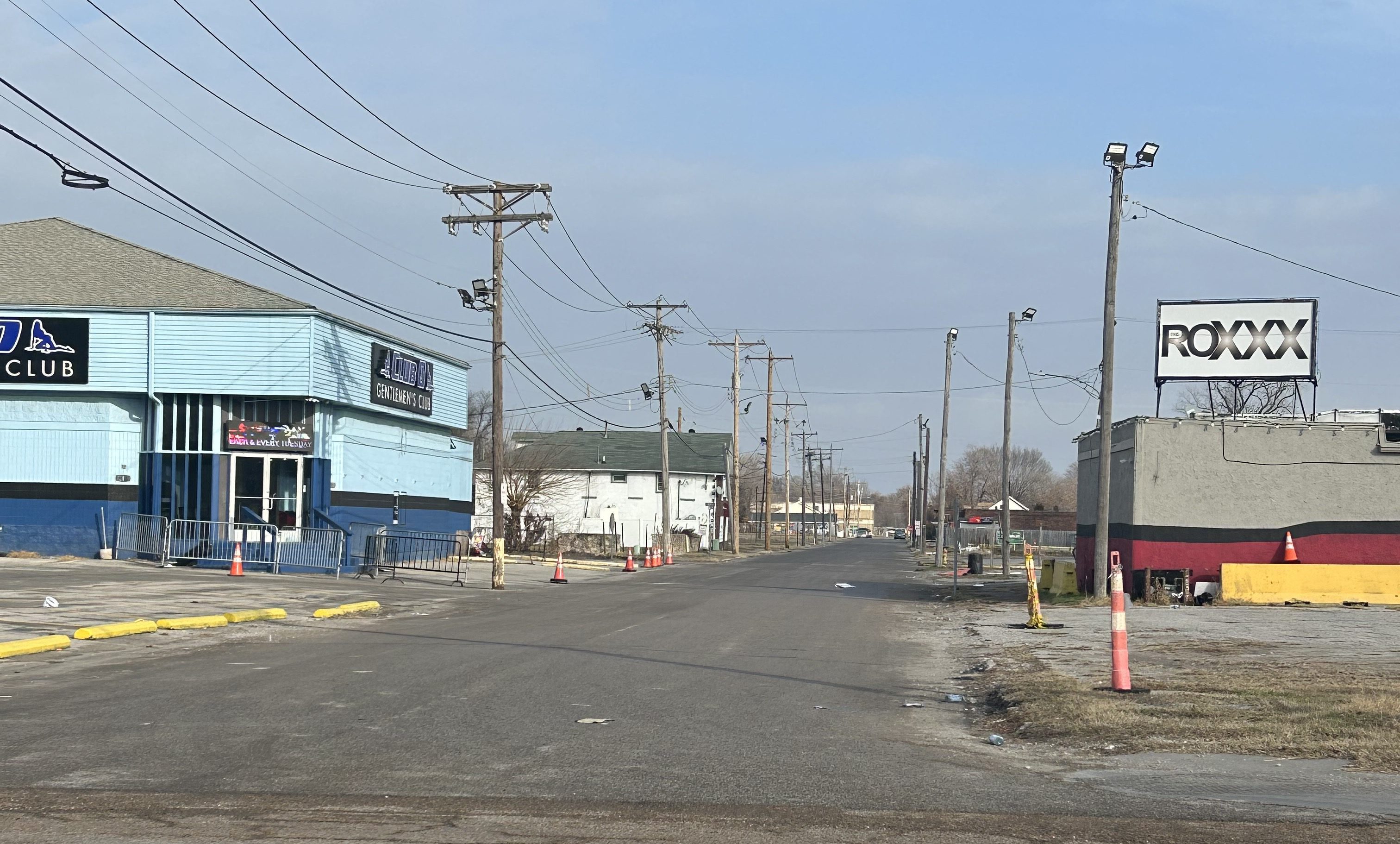
I’ve been to a strip club twice, both associated with my military service. A friend of mine and his older brother were both army veterans. When I enlisted, they decided on a pre-shipping-off-to-basic-training trip to one of the most infamous strip clubs in Brooklyn, Illinois. Infamous for something not suitable for raw talk, let alone polite conversation. My friends had fun. I can’t say that I enjoyed the outing. Strip clubs weren’t and still aren’t my type of evening entertainment.
So why a second visit? I played rugby for my military post, and the military national rugby championship was held at a local air force base. A drive in the rented van to a strip club was an inevitability. The bouncers and management were not ready for over two dozen paratrooper rugby players. There were lots of “gentlemen, such-and-such is not allowed” and “please respect the rules of the establishment” type announcements. Nothing happened. The bouncers stood at the back wall to watch us leave.
THE UNDERGROUND RAILROAD
The main way to get to Brooklyn is Illinois Route 3, which the town calls South 2nd. The town’s dozen streets are considered the oldest continuously inhabited black municipality in the United States. Brooklyn was founded by white and black abolitionists in the 1830s. The recently formed African Methodist Episcopal (AME) Church founded a mission in the new settlement.
The current AME chapel in Brooklyn may be the oldest AME congregation west of the Alleghany Mountains. Local ministers used their churches as stations on the Underground Railroad on the free-state Illinois bank of the Mississippi River. About a quarter of a mile upriver, Underground Railroad conductors ferried passengers across the river from the slave-state of Missouri. No doubt, many of them landed in Brooklyn. The total number of passengers were probably low if compared to the entire enslaved population in the United States, but for those who made the entire trip to freedom in Canada, the numbers were just right. Brooklyn, Illinois, played its part.

Quinn Chapel Church (image copyright: Richard Stimac).
BROOKLYN STRIP
My military service is 27 years in the past. Currently, I drive for Uber as a side hustle. I go anywhere and pick up anyone. I’ve been to Brooklyn plenty of times. Late one evening, I picked up a young woman quite a distance from Brooklyn. She had a large sport equipment bag. A man accompanied her to my car. They had one of the sweetest and most tender goodbyes that I’ve seen in my 8 years and 13,000 rides as an Uber driver. Her destination was a Brooklyn strip club. I figured that I was conducting her to work the midnight shift. She left an empty pint bottle of cognac in my back seat.
My 78-year-old dad of course knows of the Brooklyn strip clubs, but what he personally remembers is that during his youth, the town was famous for some of first Chinese restaurants in the East Side, as the Illinois area of the St. Louis region is called. I can’t find any evidence to support his memory, but that’s how memories differ from history. An outing to a Chinese restaurant in the 1950s industrial Midwest probably was a special event. Given that Brooklyn, and nearby Granite City and East St. Louis (both on Illinois Route 3) had much larger populations than today, there probably were diners up and down that strip of state highway. Today the railyards and factories are gone, replaced by pioneer forests, as the new growth of trees in an industrial site is called.

A Brooklyn trailer (image copyright: Richard Stimac).
HARD LIVES AND ADAPTATION
For some reason, I assumed that the strip clubs bring in enormous amounts of cash to Brooklyn. They don’t. The city’s civil budget is less than $500,000. The city doesn’t even fill the potholes leading in and out of the strip club parking lots. These are bottom-out potholes where half a tire disappears and the frame scraps against the asphalt. One morning, around 8:30, I picked up a woman at a massage parlour in Brooklyn. The building was nothing more than a mobile home painted red. She had her toddler daughter with her.
I drove her over the river from Illinois into Missouri to a neighborhood very close to my own. We stopped in front of a brick duplex bungaloid, as these common St. Louis homes are called. The building had typical Craftsman features: covered front porch; multiple eaves; fireplace; ornate brickwork; decorative colored glass and exposed wood. No doubt, the inside consisted of hardwood floors, built-in cabinetry, a carved mantel, and dark-stained molding. The lady lived on the border between two school districts, both good. Her side street had little traffic and was probably one of the safest in the entire region.
She was my last ride for the morning. As I drove the few blocks to my apartment, I thought about how areas change, or stay the same, and how the people who live in those areas adapt, or don’t. I assumed that the woman I dropped off worked for off-the-books cash. Unmarried or married, on paper she might be an unemployed mother, which has implications for government aid. When I parked in front of my building, I thought, good for her. Rich people play the system. Why not the rest of us?
I looked at my apartment building. It was still a bit run down, as were quite a few nearby apartment buildings. Two decades ago, my inner-ring suburb had a reputation as being a bit unsafe, with a bad school district. Now homes are expensive. The New York Times recently named a new restaurant here as one of the top 50 in America. But my rent is still cheap. The sheriff showed up with eviction papers for another tenant only once in the two years that I’ve lived here.
Author bio: Richard Stimac lives in the St. Louis area, Missouri, USA. He has published the poetry book Bricolage (Spartan Press), two poetry chapbooks, and one flash fiction chapbook. In his work, Richard explores time and memory through the landscape and humanscape of the St. Louis region. He invites you to follow his poetry page on Facebook.
Check out Expedia’s Illinois travel guide.
(Cultura may receive a small commission when using this link—at no cost to the user).
Join the discussion here