Malta has been on everyone’s hit list, and not just that of tourists – centuries of invasions and colonisation are confirmation of that. There’s a theory that Greeks gave the island its name—Malta is close to their word Melite meaning honey-sweet, affirming the centuries-long association with production of varieties such as ghasel tas-saghtar, the wild thyme honey harvested by beekeepers in the summer months.
The Phoenicians colonised Malta in 800BC. Then came the Romans, followed by invasions from others including the French, and British. The republic might have a continental European flavour these days with two thirds of the population conversant in Italian (and 80% Catholic), but the vibe isn’t exclusively latin. Don’t assume Malta is searching for identity—the intriguing mix of all things Mediterranean is its personality. Independence may have come in 1964, but outside nations have left their indelible marks. Its rich military and cultural history is no more obvious than in the bays of the east coast; particularly on Manoel Island or the archipelago’s capital, Valletta.
MANOEL ISLAND
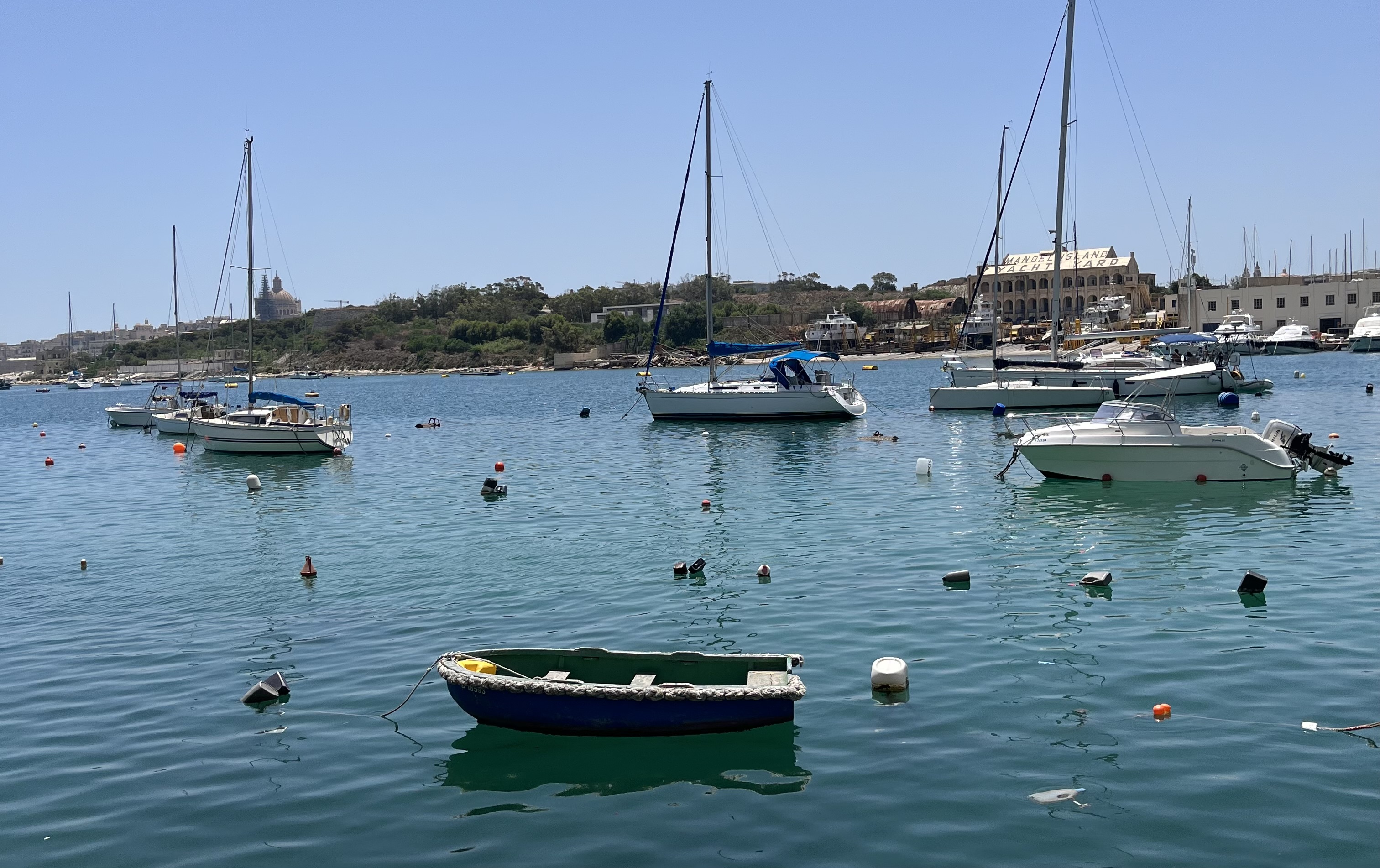
To those less familiar with their surroundings, when gazing out at sea level from Sliema across Marsamxett Harbour, the landmass on the opposite side appears as a confusing tangle of stunning sun-bleached prominences. At first glance it’s difficult to distinguish ‘mainland’ from that which isn’t. As it turns out, Manoel Island sits in the foreground, partially obscuring the mighty cityscape of Valletta.
I say island. Manoel is really only just that, connected to Sliema by a relatively tiny stone arched bridge. Despite its proximity, in contrast to the almost metropolitan busyness of Sliema, there’s little human activity going on here. Maybe a few diners at the solitary waterside restaurant on the other side of the bridge. Manoel has a boat and yacht yard but no other real amenities to speak of, and there are only so many parts of the island that can be easily reached. What it does offer is respite. An escape from the noise, bustle, traffic and pushy sales patter from day-trip touts dotted along Sliema’s promenade.

Towards Manoel Island (E. Mark Windle).
Gates and fences current guard Fort Manoel on the eastern tip at the time of writing, erected for the sake of preservation and restoration work. The fort was once the proud bastion of the Knights of St. John of Jerusalem. The knights may not have been the first to introduce Christianity to the island—the shipwrecked arrival of Paul the Apostle in the first century reputedly marks that occasion—but the ancient military religious order made a good job of imbedding the Catholic faith, ensuring its domination even after they were forced to move along by Napoleon’s lot in 1798. Geographically, Manoel guards the bay. It’s easy to see why it was once utilised for military purposes, though there is now an overriding feeling of abandonment (the British decommissioned their guns on the island at the turn of the 20th Century).
At the top of the island, just before road meets the fort, it’s worth taking time out to sit on the rocks among the rare greenery of olive trees and firs. This is Manoel’s highest point that overlooks the bay. Here, you’re provided with an instant reminder of Malta’s isolated position: smack dab in the middle of the Mediterranean, over one hundred miles from Sicily, and three hundred from the North African coast. Little wonder the island’s strategic location has been a matter of interest to a multitude of nations over the centuries.
VALLETTA
Valletta is situated just south of Manoel and is a complete contrast to its neighbouring landmark. Even the low-level view of Malta’s capital from the opposite side of the bay provides an immediate sense that this small but compact city is going to impress. Construction of what is now listed as a UNESCO World Heritage Site began in 1566, with all fort defences and the main cathedral reputedly completed within 15 years. Valletta’s etymology lies in the name of knight Jean Parisot de Valette in recognition of his efforts in defending Malta during the Great Siege, and the city currently stands as a Baroque architectural masterpiece. Heavy restoration work was necessary here after significant bombing during World War II destroyed much of the infrastructure, but you’d hardly notice.

Valletta (and happy newly weds), from Tigne Point on the opposite side of the bay (E. Mark Windle).
There are two ways of approaching Valletta from Sliema. The longer way round to Europe’s smallest capital city is by bus, which can take an hour or longer, depending on traffic. An alternative option, the boat trip from Sliema harbour-front to the jetty on the other side of the bay, is a mere eight minutes, ridiculously cheap, and much more fun. The ferry operation runs like clockwork, with non-stop trips across the bay as tourists pile on and off at each end for most of the day.
After stepping off the jetty at Valletta, the ritual to enter the city centre is to join the procession of passengers up the short but steep and winding Boat Street, past a couple of bars and into the periphery of Valletta’s grid-iron street network. If you peer down the undulating streets and pedestrian walkways there’s a feeling of a mini San Francisco about the place, with an ancient twist. But Valletta doesn’t sit on a geological fault line; it has grown through the centuries on levelled rocky hill, with sides dropping dramatically to the sea.

Outside the Bibliotheca, the National Library of Malta, in Valletta (E. Mark Windle).
I won’t lie. In the heat of summer it’s a short but heavy hike into the heart of the city to get your bearings. Just take in the journey as you pass cafes and some small bars. Catch the aroma of the Maltese coffee and don’t forget to dodge the scooters and cars as you go. Once inside the pedestrianised centre, Valletta’s town planning is logical enough. Tourist attractions are well signposted, and the perpendicular street layout and major landmarks as reference points make it an easy enough to navigate.
Cafés, restaurants and outdoor bars abound. Shops sell everything from tourist tat to upmarket sartorial elegance, all within less than one square kilometre. Various cultural and religious landmarks are scattered around. With the vast majority of the population either Roman Catholic or of a related denomination, 28 churches sit within Valletta’s perimeter. Perhaps the most instantly recognisable one is the Basilica of Our Lady of Mount Carmel. Ironically, it’s also one of the youngest, constructed in the last century on the site of a late 16th century church that was destroyed during World War II. Still, you’d be forgiven for thinking the Basilica has always been part of the furniture. It merges in well, while the 42-metre-high dome dominates the Valletta skyline.
THE OLD TOWN AND BARRAKKA GARDENS
When you’ve had your fill of Valletta’s cafés, crowds, and places of note, venture downhill to the quieter quarter of the old town. Away from all the noise, a sense of Malta’s past is evoked. The dusty streets are where low-key residential properties, the occasional boutique hotel and art galleries can be found. On the water’s edge, and without the shadowy protection of the narrow streets and alleyways, the blistering daytime heat returns.

Lower Barrakka Gardens (E. Mark Windle).
The evening’s close is best enjoyed from one of Valletta’s half a dozen or so perfectly manicured public gardens. Without a doubt, Upper and Lower Barrakka Gardens provide some of the finest views, where they overlook the Grand Harbour. Originally the private reserve of the Knights of St. John, but opened to the public during the French occupation a couple of centuries ago, the upper level features a terrace with monuments of Winston Churchill, Sir Thomas Maitland and various other dignitaries. The lower gardens display a variety of flowerbeds, a fountain and a neoclassical temple centrepiece: a tribute to British naval officer Alexander Ball. As the sun goes down on this part of the island, the Barrakka Gardens offer a perfect way to end a visit to the jewel in Malta’s crown.
(Previously published in Go Travel magazine. Permission obtained for reproduction).
Join the discussion here