Part 4 of personal reflections and historic explorations of the Grafton to Cairo length of Illinois Route 3 by writer and poet Richard Stimac.
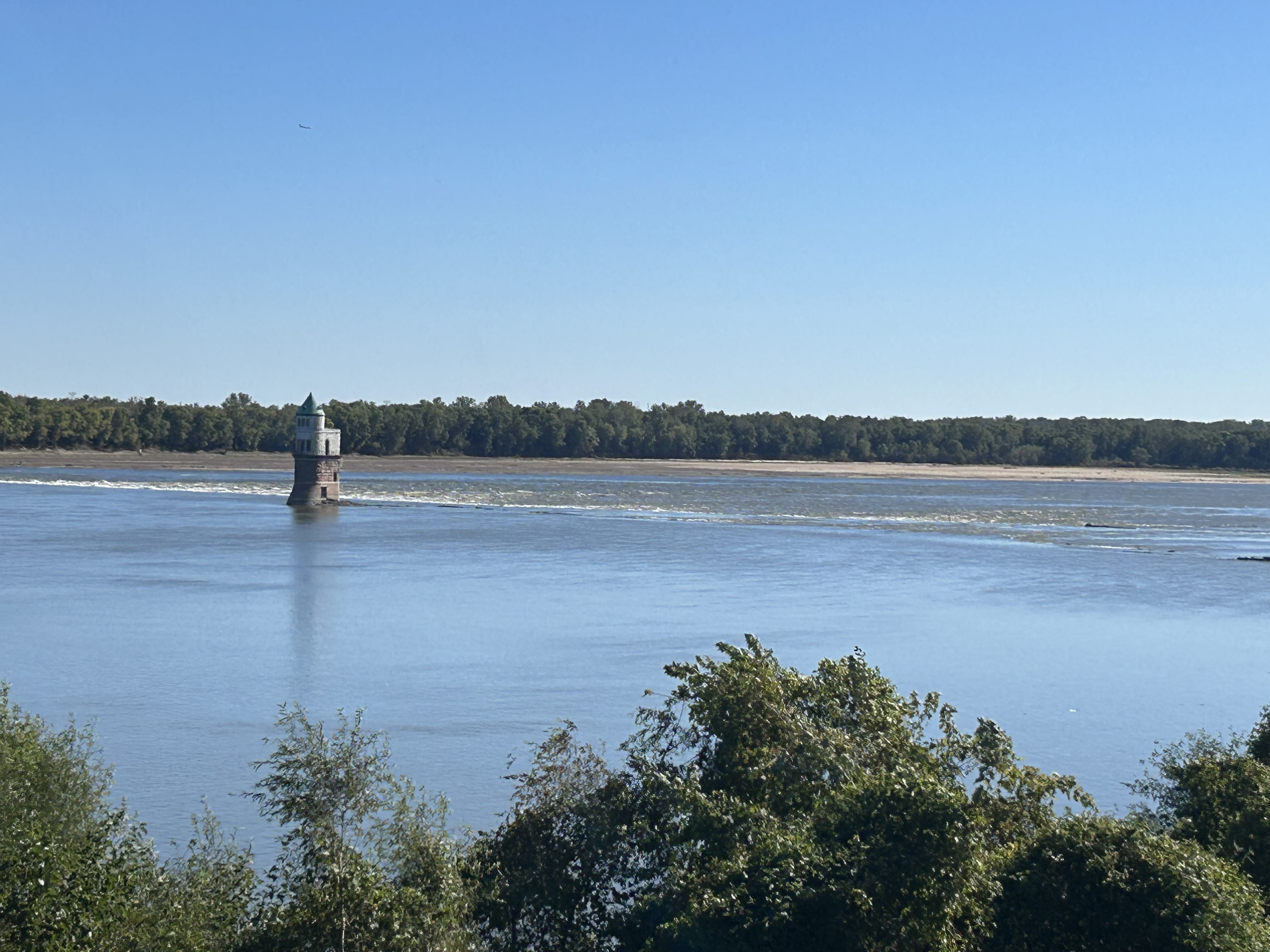
My Boy Scout troop used to camp at the mouth of the Cahokia Creek Diversion Channel. We didn’t choose the location for the name but because it was where the Lewis and Clark Expedition camped for the 1803 winter before heading up the mouth of the Missouri River directly across the Mississippi. The only monument was a circular concrete base, with eleven columns for each state the expedition visited during its survey of the U.S.’s newly acquired Louisiana Purchase and its watershed from France. The park was nothing more than overgrown woodlands. Nearby oil refineries made the water in the diversion channel suspect even to be close to, and the Mississippi wasn’t much cleaner.
SCOUT CAMP ON WOOD RIVER
Nonetheless, we camped with our canvas tents held up by steel rods. At night, we built a fire and performed generic Indian-based ceremonies. The Boy Scouts were obsessed with Native American culture. Our local governing body was the Cahokia Mounds Council, named after the 1,000-year-old abandoned Mississippian city nearby. The Order of the Arrow put recruits through the Ordeal, which included fake deer-skin outfits and face paint. We came up with Twotongues or Runningbear as team names. Even today, there is even an Indian Lore Merit Badge with a Plains Indians feathered headdress as its icon. That night we planned our own war party against another troop.

The stockade (image: Richard Stimac)
A Frenchman named Nicholas Jarrot owned the land that Lewis and Clark used. Jarrot owned hundreds of acres along the Riviére du Bois (Wood River). Lewis and Clark named their winter quarters Camp Dubois. The American expedition didn’t camp like the Scouts did—they built a full-fledged frontier fort with palisade walls and blockhouses. The European and White American populations were scarce in the area, but local tribes already understood what was happening.
Only fifty years earlier, the Odawa war chief Pontiac led resistance against British expanse in the Great Lakes region. Ten years after Lewis and Clark, a Kickapoo war party killed over a dozen American settlers near Wood River. The chance of a poorly defended winter camp being overrun was greater than Lewis and Clark could take. Today visitors can tour a reconstruction of the military post and view a replica of the keelboat the expedition used. Both Jarrot and Pontiac are buried in Cahokia Heights, thirty miles south on Illinois Route 3.

Keelboat replica (image: Richard Stimac)
THE RAID
On the weekend of the Scout outing, another troop pitched camp in an open field on the other side of a copse. A raggedy trail connected the two. Each troop had its own flag, bicoloured, red on the top half, white below. A charge of the Boy Scout symbol sat in the middle. The troop number was at the top. The city and state at the bottom. Troops could even earn streamers to hang from the unit flat, like unit streamers for military units. All this was fitting for the Scouts unofficial paramilitary structure. The objective of our raid was this other troop’s colours.
The plan was to wake up in the middle of the night. A few of the boys were night owls. They stayed awake until dawn with no loss of energy the next day. Closer to midnight, they began waking us up. The scoutmasters and adult chaperons were asleep in their tents pitched on the far side of our camp. We all had heavy metallic flashlights that came with a plastic filter for use at night. The initial idea was to climb down to the river and wade along the bank to the other camp. The mud was too thick and the slope too steep. We decided to follow the trail. At the trailhead for the clearing, we turned our red lights out and crouched in the foliage. Tasks were assigned: grab the unit flag; knock down the dining tent; uncap and knock over the water cans; raid the cooler and food panty; and finally, pull up as many tent stakes as possible. All this with whooping.
LEWIS AND CLARK EXPEDITION
The Lewis and Clark Expedition lasted two and a half years. Most interactions with Indian tribes were peaceful. At times, there were tense negotiations. Only one encounter ended in bloodshed. In 1806, on the return down the Missouri to St. Louis, a fight broke out between Lewis and some of his crew and a group of Piegan Blackfeet warriors. Two Piegan were killed. One expedition member was wounded. The Americans slipped away before hostilities expanded. The only other near violent interaction was two years earlier.
The quick intervention by Teton Sioux Lakota Chief Black Buffalo avoided violence over a passage fee for the Americans. In exchange for free passage through Sioux territory, the Indians received a tour of the American camp. The U.S.’s annexation of the Louisiana Purchase was peaceful, for the most part. Direct confrontation between American settlers and Midwest and Plains Indians began in the 1840s, with that is called the Plains Wars beginning in the next decade.

At the confluence (image: Richard Stimac)
Our raiding party won the battle but lost the war. We stole the other troop’s colors and knocked down a few tents. The lids on the Jerry cans of water were too tight to loosen. The food pantry was padlocked. As we celebrated in what we claimed as our territory, some of the boys from the other camp bolted out of the trail. A full-on fist fight broke out. Lips busted open. Noses bloodied. At least one eye swelled shut. The other troop’s adult leaders were fast on their Scouts heels. Ours woke up with the noise. The battle was over within minutes. We returned the colours, and next morning, both troops came together for a long lecture on Scouting principles. The adults forced us to shake hands, and we parted on grudgingly given peace terms.
Author bio: Richard Stimac lives in the St. Louis area, Missouri, USA. He has published the poetry book Bricolage (Spartan Press), two poetry chapbooks, and one flash fiction chapbook. In his work, Richard explores time and memory through the landscape and humanscape of the St. Louis region. He invites you to follow his poetry Facebook page.
Join the discussion here