Joining the dots between a North Carolina soul band and New Orleans music legend Allen Toussaint.
For Roger Branch, sound engineer and founder of the sixties R&B band The Tempests, New Orleans had an attractive pull for studio engineering and production work. Like most musicians in the South, there was a deep affinity for the city’s musical cultural vibrancy. Branch had forged professional links with key industry figures there like Allen Toussaint and Marshall Sehorn, from his early days as an engineer at Reflection Sound back in North Carolina.
Toussaint and Sehorn had worked together at least ten years prior to the hook-up with Roger in the early 1970s. Toussaint’s presence in New Orleans was also already established: he was responsible for defining the Nola R&B sound of the late 1950s and early 1960s, a consequence of his feverish absorption country, blues, Creole rhythms and honky-tonk piano influences. As a musician, song writer arranger and producer, Allen Toussaint was the driving force behind many hits of the day during the same time that The Tempests were busy doing their thing on the east coast.
Allen Toussaint came from a poor but musical background, and heavily influenced by his parents, neighbours and other musicians who visited his family home. As a young adult, he played locally with most of the popular local New Orleans artists until scouted by RCA for a national market. Toussaint’s initial foray into the music industry was as Joe Banashak’s producer and A&R representative. The early ’60s provided Banashak’s Minit and Instant labels with a string of hits which typified the New Orleans R&B sound of that era.
Toussaint met Sehorn after returning from a two-year draft in the US army. Sehorn was a Carolinian who played guitar in various college bands before a stint as the A&R guy at Fire and Fury Records in New York. The pair’s first collaboration was on some Lee Dorsey sessions for the labels (with limited success), before settling in New Orleans to form Sansu Enterprises and Sansu Records, Tou-Sea, Deesu and other recording label imprints.
With Toussaint’s skills as a songwriter, pianist, and producer, and Sehorn’s industry knowledge, Lee Dorsey was brought back into the studio. An arrangement with Bell subsidiary label Amy ensured that Ride Your Pony, Working In The Coalmine and Holy Cow benefitted from national exposure and distribution.
SEA-SAINT STUDIOS THROUGH THE 1970s
Cash and acclaim started to roll in with the Dorsey releases, though Toussaint and Sehorn were in danger of becoming victims of their own success. While the list of hits grew, other recording studios were used around the city including those owned by Cosimo Matassa or facilities outside of Louisiana. The need to operate their own studio for convenience and to facilitate more control of production was clear.
By 1973, a contract with Warner Bros. for composition, production and recording work enabled the duo to finance and build Sea-Saint studios on an old service station site at 3809 Clematis Street in the Gentilly area on New Orleans’ East Side. Work poured in from local sources and national labels keen to use Sea-Saint’s contemporary recording facilities. The major labels would keep Sea-Saint afloat financially, and the studio targeted its services specifically towards them. Sea-Saint rapidly became associated with multiple national hits across the soul, pop and country music spectrum. The 1970s saw in Labelle’s Lady Marmalade, two of albums by Paul McCartney and Wings, and a series of Billboard chart smashes by Glen Campbell, Paul Simon and Joe Cocker.
When Cosimo Matassa when closed one of his studios in 1978, Sea-Saint joined forces. Services could now be extended to a wealth of R&B producers resulting in further recordings by Bobby Powell, Lee Bates and Tony Owens. Sea-Saint’s peak of success may have been the 1970s, but the studio remained active throughout the following decade.
Regardless of musical genre, Toussaint and Sehorn’s studio remained go-to in these parts for anyone after quality recording facilities, engineering and production. Roger Branch’s first association with Toussaint and Sehorn was when they first started using Reflection Sound Studios in Charlotte, while waiting for completion on Sea-Saint studio’s construction. Branch’s background in electronics served him well, and eventually he would also relocate. Sea-Saint needed someone with technical know-how as well as musical ability.
By 1990 Roger Branch was firmly installed as the studio’s sound engineer, and set to work on New Yorker Willy DeVille’s new album. The ex-Mink Deville lead singer had moved into a new creative phase, drawn to the latin, blues and soulful roots of old New Orleans. This culminated in Victory Mixture, a project started after a conversation about the possibility of covering old delta songs and an evening of DeVille playing old Louisiana 45s with his friend Carlo Ditta.
THE HARD PACK PROJECT
Sea-Saint Studios would also be the location for a latter day professional reunion for Roger, and former Tempests members Van Coble and Nelson Lemmond:
“Even though our version of The Tempests had disbanded a long time ago, a few of us would get together to work on projects every few years” Nelson commented. “Probably the most fun was doing a promotional cassette album for Camel cigarettes in the late 1990s. Through my point-of-sale advertising company I’d done a lot of work with tobacco giants R.J. Reynolds on their shop displays and billboard signs. I kept hounding them that I had a band in mind who sounded fantastic and we should record them for their advertising.
Eventually they gave in. Basically, it was a case of here’s a piece of money, go do some demos — now shut the fuck up and get out of our hair. I got Van and Nat Speir from The Rivieras to write some material right away. We called in on Roger Branch so we could get a few local musicians together. A month was spent on that album. We stayed at the Pontchartrain, one of those grand old hotels in the centre of town. Our daily ritual was to get up at around 11am for the recording sessions, eat breakfast at K-Paul’s Louisiana Kitchen and to go over to the studio and work through until 2 or 3am. After that, it was back to the hotel for turtle soup and gumbo. Rinse and repeat.”

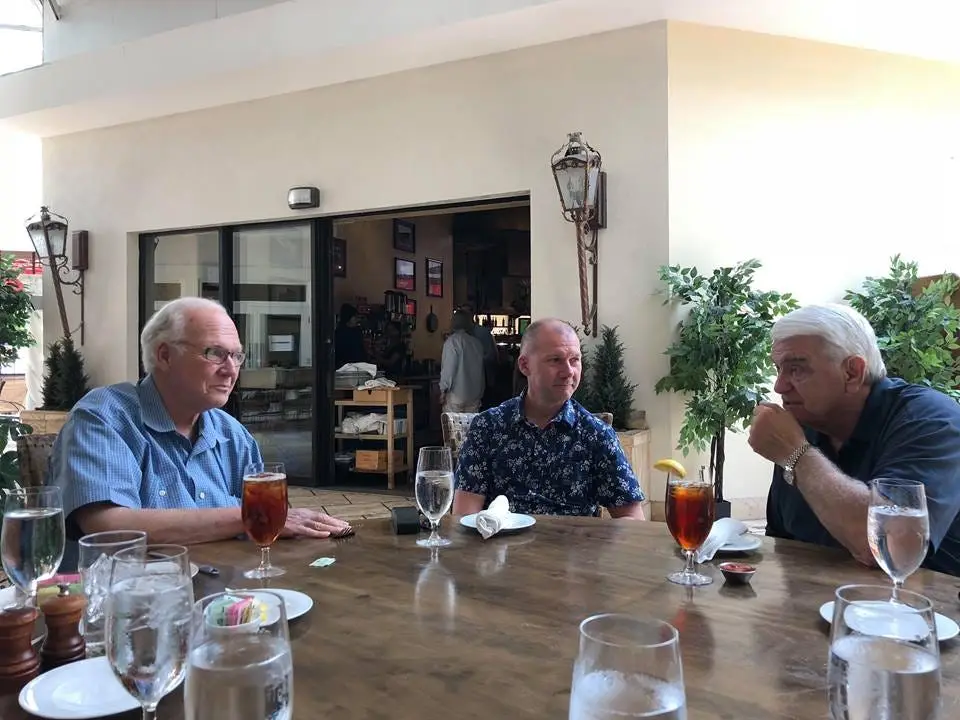
From left, Nelson Lemmond, the author, and Van Coble (image credit E. Mark Windle)
“We considered the idea of using all-star New Orleans line up. Marshall Sehorn and I tried our best to drag Fats Domino out of bed at noon one day, which he really didn’t thank us for. So we abandoned that idea. In the end the decision was the project needed to seem like it was featuring one band. We came up with the concept of a band of animated Camel characters. A bar band was used that played on Bourbon Street. Luther Kent was their singer, who previously played with Blood, Sweat and Tears after David Clayton Thomas left. Luther now had a big blues band called Trick Bag — whenever B.B. King or Bobby Bland were in town they would be hired to back them up. Allen Toussaint played on some of the songs to help us out. The guy was a genius. I remember on the first day the rhythm section was having a real problem with tempo. Very politely Allen asked if he could sit in. He straightened everything out immediately.”

HURRICANE KATRINA
When Hurricane Katrina hit New Orleans, it made global news. More than a century of musical and cultural heritage was wiped out in an instant. The storm surge and Mississippi levee failure had catastrophic effects: 53 breaches occurred in what were mostly ill-designed and constructed flood protection barriers. Eighty percent of the city was flooded, and water levels remained high for weeks after the storm.
The death toll attributed to the violent effects of the storm is still disputed but placed conservatively between 1000–1500 in New Orleans area alone. Hundreds of thousands were made homeless, forced to move from the area, and many were either unable or did not wish to return. Given that more than half of New Orleans residents prior to the storm were African-American, the impact on the black music industry was devastating.
On 28th August 2005, Sea-Saint Studios was wrecked by flooding and winds. Toussaint found himself without a home, a business and most of his possessions. Like thousands of others in the immediate aftermath, he initially sought safety at the Astor Crowne Plaza Hotel, then relocated in the longer term to New York before eventually returning to New Orleans.
Roger Branch managed to remain in New Orleans: “Four feet of water had flooded the ground floor, and Katrina had damaged the Sea-Saint building beyond repair. But by a stroke of luck, I had a place — originally an office — on the other side of town. It was built in an elevated position. Although it only a few blocks away from the Mississippi River, it escaped damage by Katrina, other than some roof issues that could be quickly repaired”.
Those office premises became Oak Street Recording Studio, which to this day continues to record new and established artists.

The devastating effects of Hurricane Katrina didn’t deter Toussaint from picking up his career again. Within six months he was performing on David Letterman’s Late Show. Offers of a number of live performance opportunities around New York were welcomed to help recover his finanical situation. Eventually Toussaint returned to a rebuilt, smaller New Orleans.
Further cash injection came via an award-winning TV advertisement that used his song Sweet Touch of Love. Toussaint would continue to support the revived New Orleans music scene. Already inducted into the Rock and Roll Hall of Fame, by 2013 his contribution to the industry was acknowledged by the Louisiana Music Hall of Fame and the Songwriter’s Hall of Fame. The National Medal of Arts awarded by U.S. President Obama was the icing on the cake.
(Modified excerpt from the book The Tempests: A Carolina Soul Story).
Join the discussion here