Part 10 of personal reflections and historic explorations of the Grafton to Cairo length of Illinois Route 3 by writer and poet Richard Stimac.
St. Louisans like to make much of the city’s French heritage. There’s the name, of course, of the only sainted French king. Once the official symbol of the city before the Arch, the apotheosis statue of St. Louis stands in front of the St. Louis Art Musuem. You’ll find fleur-de-lis all over the place, including the city’s flag. St. Louis claims the third largest Mardi Gras in the world to first-place Rio de Janeiro and second-place New Orleans. The St. Louis City Hall was modeled on the French Renaissance Hôtel de Ville in Paris. Then there are the French street and place names pronounced in a distinctive St. Louis way: Gravois as “grav-oi”; Chouteau, “show-toe”; Bellefontaine, “bell-fountain”; Creve Coeur, “creev-core”; and Des Peres as “duh-pair.” The list seems endless. Linguistic evidence suggests that contemporary St. Louis pronunciation of French words descends from centuries old French pronunciation called Paw Paw French. Nearly but not entirely extinct.
ENTERING SAUGET
If you cross the Mississippi River into Illinois, you find deeper French roots for a hundred miles south on Illinois Route 3. The East Side, as the eastern Illinois side of the river is called, houses the strip clubs, nearly-24 hour bars, and music venues where up-and-coming and washed-up bands play, along with drive-through liquor stores that accept cash in place of state ID.
Directly across the river from the Anheuser-Busch in the Soulard neighbourhood of St. Louis is Sauget (“saw-zhay” or “so-zhay”), the key word in a common St. Louis phrase We ended up in Sauget. Enough said. Everyone understands. The village has less than two hundred residents, most of them part of the extended Sauget family that supplied every mayor since the village’s founding in 1926.

Approaching Sauget (image copyright: Richard Stimac).
With over 14,000 rides as an Uber driver, I’ve had plenty of pick-ups in Sauget. Most of them were very late in the night, or very early in the morning, depending on your perspective. Sometimes I begin driving early and pick a drunk up, let’s say at 5:30 am. The conversation often goes something like, “Driving late today?” “No,” I say. Then confused silence as the person in the back seat tries to figure out the logic.
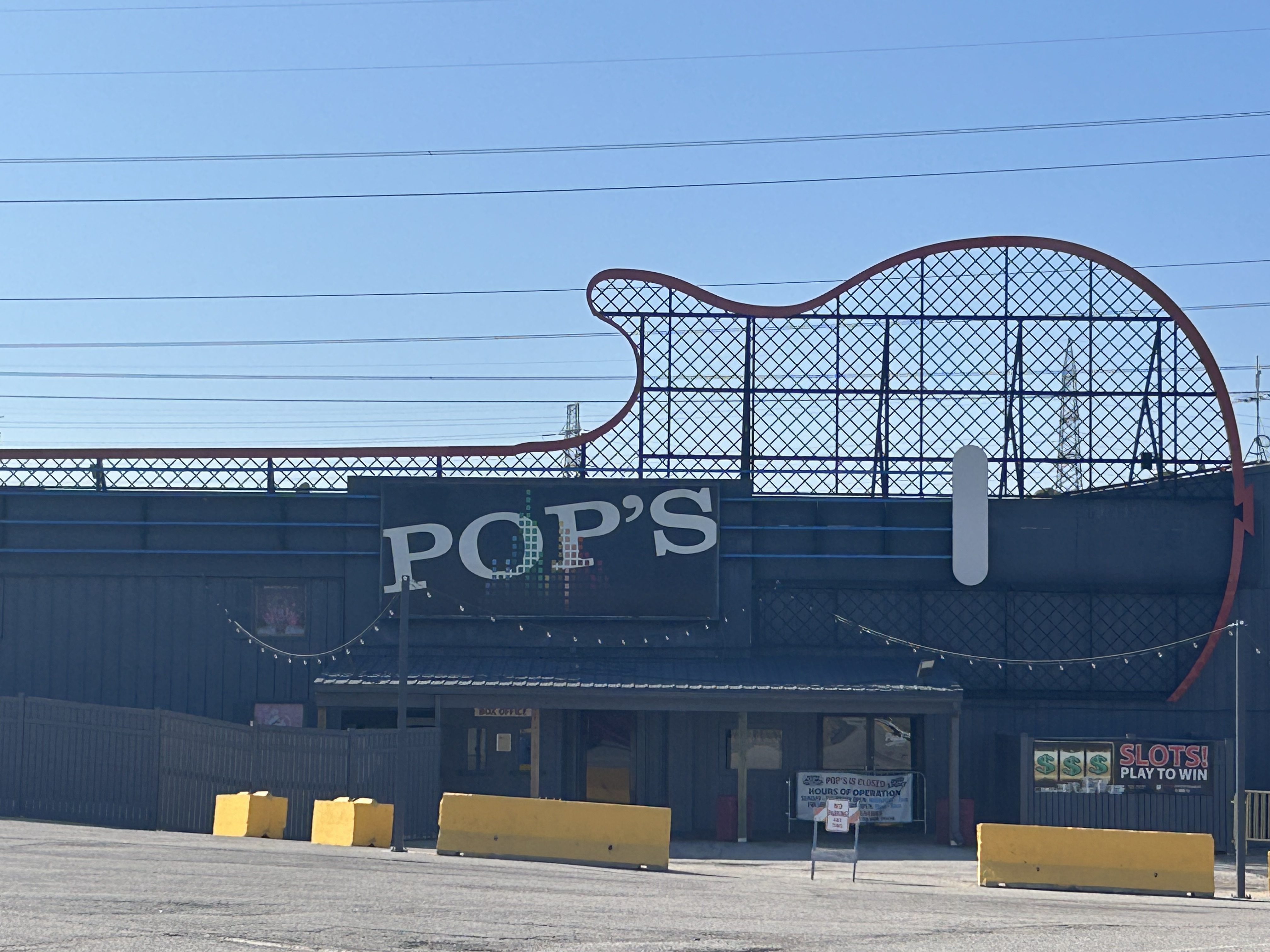
Many Sauget riders are at Pop’s, the prefab warehouse turned into a 1,500-plus person event space that hosted Mötorhead, Bruno Mars, and nearly every hair-metal band that had a hit thirty years ago, all across the street from a massive chemical plant, which is the heart of Sauget. One time, a couple came out of Pop’s at 6:30 am. A dozen people were going in. I’ve picked up many out-of-town businessmen in Sauget, too. There’s a strip club next to Pop’s, “#1 Gentleman’s Club in St. Louis,” the website reads. I’ve never been inside, but I confidently assume it’s not T.S. Eliot’s idea of a gentleman’s club. No English cheese course here, just plain American cheesecake.
MONSANTO
John Queeny founded the St. Louis-based chemical company Monsanto in 1901. To avoid St. Louis City regulations, he moved production to the East Side, an area he named Monsanto, after the company. Monsanto soon incorporated as Sauget, with a Sauget as the first mayor. The tangential French connection is interesting. Queeny’s wife Olga’s maiden name was Monsanto, a family name lost to history but for a few centuries was one of the wealthiest Sephardic Jewish families in the world. They settled in New Orleans in the 1700’s and extended upriver, no doubt, becoming the type of wealthy Mississippi river valley family Kate Chopin used as models for The Awakening.
The Monsanto family began in Portugal, fled to the Netherlands during the Portuguese Inquisition, and ended up in French Louisiana. By the time he founded Monsanto, Queeny was a very successful international drug salesman who ran in wealthy circles in the East where he met and married Olga. The Monsanto family doesn’t really exist anymore—not as a wealthy dynastic family at least. Apparently, you can still find scions in the Caribbean and southern Louisiana.

Sauget chemical plant (image copyright: Richard Stimac).
UBER RIDE
I remember one strip club ride very well. The rider’s name was John. When he approached my car, I could tell that he was drunk. I’ve only had two or three problems with drunk riders. I didn’t want to add another one. The ride wasn’t for him, though. Two women followed him to my car. He opened the door for them and told me to take care of them. In fact, he said something, “Take care of my girls.” They giggled and thanked him with a slight but obvious accent. The ride was 45 minutes to a new suburb further east into suburban Illinois. They were southeast Asian, that region of the world once a French colony. Given the St. Louis regions low cost of living, the State Department sent many refugees and immigrants here throughout the years. They chatted with each other the entire trip. They mentioned how nice John was, how much they liked him, he was always so polite, and so on. I assumed that they had a few hundred dollars of John’s cash in their pockets. I gave them credit for that. Their neighbourhood was new. Curving streets. Cul-de-sacs. Low-sloped curbs. Each house had a two-car garage. Many front yards had young saplings. I was paid and thanked for the ride. I don’t remember if John left a tip.
I returned to Missouri over the Poplar Street Bridge. Blue flood lights lit the Arch so that it glowed like a hologram. As the tallest monument in the United States, the Arch symbolises St. Louis as the Gateway to the West when European-born and European-descended settlers trekked east to west. The movement north and south on the river is remembered only as a relic of commence. As time passes, so does the meaning of directions.
Author bio: Richard Stimac lives in the St. Louis area, Missouri, USA. He has published the poetry book Bricolage (Spartan Press), two poetry chapbooks, and one flash fiction chapbook. In his work, Richard explores time and memory through the landscape and humanscape of the St. Louis region. He invites you to follow his poetry Facebook page.
Join the discussion here