Part 12 of personal reflections and historic explorations of the Grafton to Cairo length of Illinois Route 3 by writer and poet Richard Stimac.
Like many American men, my dad is obsessed with war. War movies. War documentaries. War books. And like other American men obsessed with war, my dad is interested only in the American Civil War and World War II. Not World War I. Or the Spanish-American War. The Boxer Rebellion. The War of the Triple Alliance. Just the American Civil War and World War II, with the addition of the Vietnam War, one in which he fought in 1968: the year that I was born.
His amateur study of the Vietnam War is an exercise in autobiography. He knows something happened during those years, something happened to him, but he’s not quite sure what it was. That’s a common experience with veterans, if not us all. There’s a scene in Ernest Hemingway’s short story “Soldier’s Home” where the main character Harold Krebs reads books about World War I battles that he took part in. By learning about the greater history of the war, Krebs better understood his own life story. He learned to say, “On this day of this battle, such and such happened on the front”. Then he could look at a map and point, “There’s where I was.”
He only knew himself in hindsight, as all of us do. “Life can only be understood backwards; but it must be lived forwards,” Soren Kierkegaard wrote. We live in the present and understand our lives only when we can look back to what we were.

The Liberty Bell at Kaskaskia (image copyright: Richard Stimac)
KASKASKIA AND FORT DE CHARTRES
In 1717, the French moved control of the upper Mississippi River Valley to New Orleans from Quebec. They made Kaskaskia the capital of the Illinois Country, an ambiguous term in English. In English, “Illinois” is a descriptive adjective to the noun “Country”. In French, the name was “Pays des Illinois”, literally the “land of the Illinois” and a reference to the local confederation of local tribes. Here, “Illinois” is the possessive. The French name acknowledges the someone already on the land.
Due to the constant movement of the river, the current Illinois town of Kaskaskia sits on the west bank of the Mississippi River, like a peninsula surrounded by the Missouri Ozarks. Technically, Kaskaskia is on an island surrounded by a side channel of the Mississippi. Across the river from Kaskaskia, on Illinois Route 3, is the town of Chester. This is the home of Menard Correctional Center, the state of Illinois’s maximum-security prison.
Prison labour built the late 19th century buildings with porticoes, Corinthian columns, and ornate stonework using locally quarried limestone. The original prison buildings are beautiful. Like a medieval fortress, a flood wall separates the prison from the river. Coupures allow traffic in and out. In 2022, the wall held back a crest of nearly fifty feet.
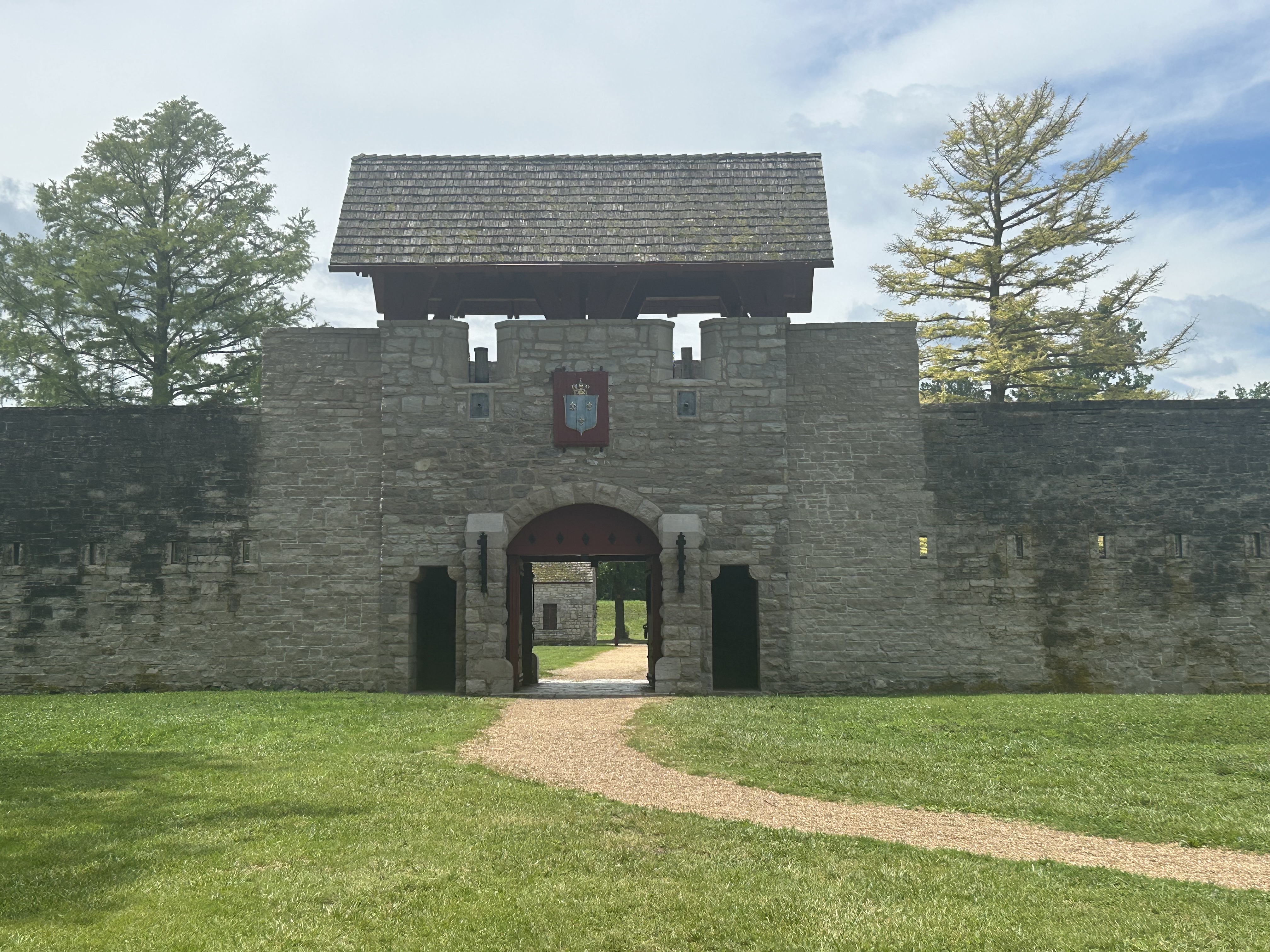
Ruins of former French colonial forts dot the Illinois side of the river near Kaskaskia. Only one has been restored: Fort de Chartres is an hour’s drive north of the old capital. The site is a state park and hosts an annual Rendezvous. The fort itself is four acres within the 1,100-acre state park. The French built then rebuilt the fort when it was destroyed by flooding.

Forte de Chartres (image copyright: Richard Stimac).
The state of Illinois began rebuilding the fort in the early 20th century, with much of the work done by the Civilian Conservation Corps of the New Deal. Two bastions with bartizans, the main gate, numerous interior buildings, and the powder magazine have been restored to their original states. In 1993, breached-levee flood water reached fifteen feet deep among these structures.
THE RENDEZVOUS
When I was young, we took at least one family trip to the Rendezvous. When you have kids, there is an imperative to go on family trips one would never go on only as an adult. I took my daughter and her mom to Fort de Chartres for a day trip, too, though not a Rendezvous weekend. I don’t know why we went. It seemed like a thing to do, to get out of the house as the saying goes. Neither of them probably remembers. I don’t remember my childhood trip, not well, at least. I do have images in my mind, though I can’t differentiate between memories and photos I’ve seen. The men, almost all older white men, were dressed in 17th century French and British military uniforms. They were fat, for the most part. Odd, I thought, given a diet of hardtack, salt pork, and dried beans, augmented by what they could kill, buy, or steal locally.

Re-enactors at Forte de Chartres (image copyright: Richard Stimac).
More images. The uniforms were impeccably clean even after travelling upriver from New Orleans or down the Ohio River. Bonnet-clad women baked bread. I have no idea if the Indian re-enactors were historically accurate, or even Indian. I assume so on the first point, not on the second. The historical re-enactment subculture tends towards the obsessive when it comes to preciseness. The Friends of Fort de Chartres website has photographs of men with partially shaved heads, war paint, leather leggings, feathers, flintlocks—the works, like straight out of the movies. The Indian re-enactors do have darker skin than the British Highlanders they walk beside. Maybe more bronze. I wonder about the thin line between tribute and mockery, between copy and ridicule. Only one recently founded tribal reservation exist in Illinois today. The descendants of the Illinois Confederation tribes live in Oklahoma.
CULTURAL SUPPRESSION
The French history of the upper Mississippi River Valley exists only on paper in place names and historical markers. There are a few dozen native speakers of Paw Paw French, as the French dialect of the southern Missouri-Illinois area is called. As with so many minority groups, Paw Paw French was actively suppressed during the Americanisation era of the late 19th and early 20th century. Both Missouri and Illinois once had large German speaking populations, too, which resulted in a strong beer brewing and wine vinting industries. These still exist, though not at localised as in the past. World War I anti-German sentiment, law, and vigilante violence effectively eliminated the German speaking population, who assimilated, and whose descendants might hold anti-immigrant views today. Once a living tradition is lost, it’s impossible to regain, only to recreate in facsimile. Two young men tried to revive Paw Paw French a few years ago. The on-line free course was last updated in 2023. (END OF PART 1).
Author bio: Richard Stimac lives in the St. Louis area, Missouri, USA. He has published the poetry book Bricolage (Spartan Press), two poetry chapbooks, and one flash fiction chapbook. In his work, Richard explores time and memory through the landscape and humanscape of the St. Louis region. He invites you to follow his poetry Facebook page.
Join the discussion here